
Module 2 · Scoring
Understanding Engine Scores
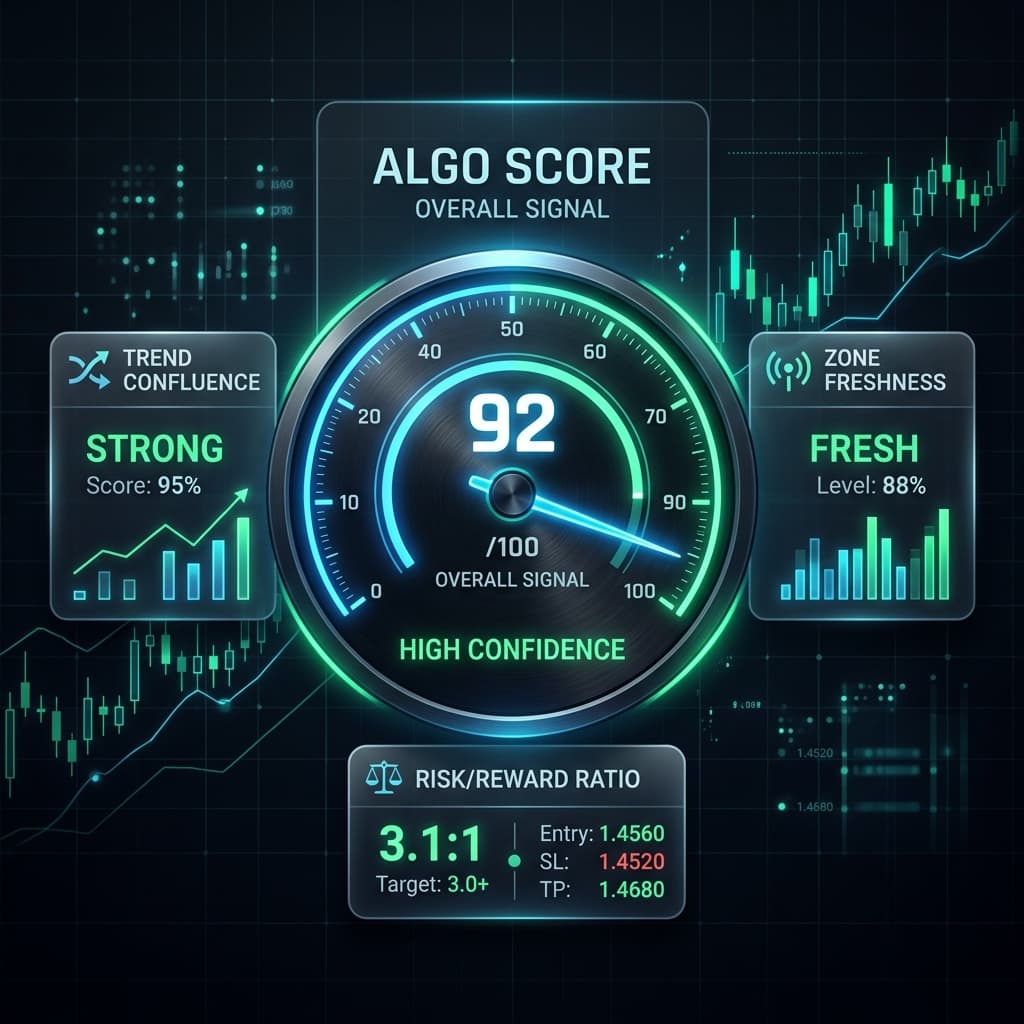
Decoding the shape of a high-conviction candidate. Top-level weights are public; the exact formulas, thresholds and freshness decay rules stay private.
Why score trades at all?
In manual trading, emotions decide whether a setup “looks good.” The DhanVeda engine strips that out. Every candidate surfaced by the scanner is graded on a strict 0–100 scale using purely mathematical conditions.
Only candidates that clear an internal high-conviction threshold are surfaced to Pro users with full diagnostics. Basic users see the same candidates with entry, stop-loss and target levels — the internal score breakdown is reserved for Pro.
The four components
Trend Alignment
≈ 30 pointsThe engine evaluates higher-timeframe structure (higher highs / higher lows). Trading in the direction of the larger trend earns the base score.
Zone Freshness & Departure
≈ 30 pointsA zone that has never been tested earns maximum freshness points. The engine also weighs the body-to-range ratio of the candle leaving the zone.
Multi-timeframe Confluence
≈ 20 pointsWhen an entry zone is nested inside a macro zone on a higher timeframe, the candidate ranks higher because multiple horizons agree.
Risk-to-Reward Ratio
≈ 20 pointsDistance to the logical stop-loss versus the next opposing zone (target). If reward-to-risk falls below a reasonable floor, the candidate is penalised heavily.
What we deliberately don’t publish: sub-formulas, exact trigger thresholds, the freshness decay curve, regime-gate rules, exact ATR / volume / IV / OI cut-offs, backend table names, Python code or broker execution logic. That keeps the engine an edge — not a recipe.
See the score in the preview
Pro users will see top-level score badges on every candidate card. Today’s preview shows the locked layout.